Athletics
Why a headwind costs a sprinter more than a tailwind returns
Wind assistance and wind resistance are not symmetrical in their effects, and the reason lies in how air resistance scales with speed rather than in anything about the runner.
Air resistance does not scale evenly
The force a runner must overcome to push through the air increases far faster than the speed at which the runner is travelling. That relationship means the penalty for running into moving air is larger than the benefit of having the same air push from behind. A headwind therefore removes more from a performance than a tailwind of identical strength is capable of restoring to it.
The asymmetry is a property of the physics rather than a quirk of any particular athlete or any particular event. It explains why athletes are far more concerned about an adverse reading than they are pleased by a favourable one.
Why the fastest part of a race suffers most
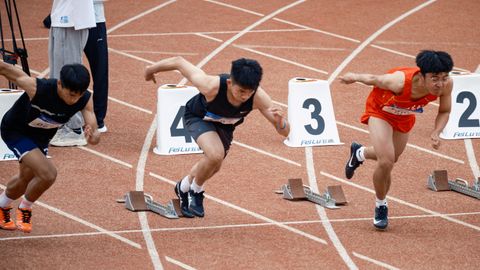
Resistance grows with speed, so the section in which a sprinter is travelling fastest is also the section where the wind extracts the largest cost. In a short sprint that section falls in the middle of the race, once acceleration has finished and top speed has been reached. A headwind therefore does its greatest damage precisely where the athlete has the least capacity to compensate through additional effort.
Attempting to compensate consumes energy that was budgeted for holding speed through the closing stretch of the race. The visible result is a runner who appears to fade late when in fact the deficit was created much earlier.
What the wind does to mechanics
Beyond the direct resistance, moving air disturbs the position of the limbs and the trunk during each stride cycle. A sprinter running into wind tends to lean further forward, which shifts the mechanics away from the upright posture that top speed requires. Crosswinds are more disruptive still, because they act unevenly on a body that is rotating and swinging through every stride.
Athletes correct continuously for these disturbances, and the corrections themselves consume energy and reduce the efficiency of the stride. This component of the cost is rarely discussed and it accounts for part of why adverse conditions feel worse than the numbers suggest.
Why a tailwind gives back less than expected
A following wind reduces the air the runner has to displace, but it cannot push the athlete faster than the ground contact allows. Sprint speed is limited by how much force can be applied to the ground in the very short time each foot is down. Air assistance does nothing to improve that limit, so the benefit is capped by a constraint the wind cannot influence at all.
The runner also has to adjust to a slightly altered balance, which introduces a small cost that offsets part of the gain. The net effect is a real but modest improvement, considerably smaller than the loss an equivalent headwind would impose.
Why conditions vary within one stadium
Stadium architecture channels air in ways that produce very different conditions on the track than in the open ground outside it. Gaps in the stands, the height of the roof and the orientation of the straight all create local effects that vary along the runway. Wind readings are taken at a specific point over a specific interval, so they describe a sample rather than the whole race.
Athletes in different lanes and different heats can therefore experience conditions that the recorded figure does not capture. This is one reason comparisons between performances at different venues are less straightforward than they first appear.
- Air resistance rises disproportionately as speed increases
- A headwind removes more than an equivalent tailwind restores
- Wind also disrupts mechanics, not only forward progress