Athletics
Why the long jump is decided on the penultimate stride
The distance achieved is largely determined before the athlete reaches the board, in a stride that lowers the body and sets up everything the take-off can produce.
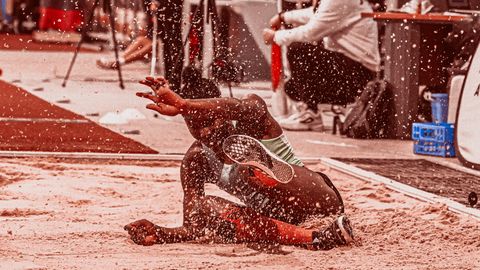
What the penultimate stride does
The second-to-last stride before take-off is deliberately longer and flatter, which lowers the athlete's centre of mass toward the ground. Lowering it creates the vertical distance through which the body can be driven upward during the final contact with the board. Without that lowering, the take-off has almost no range in which to generate lift, and the jump becomes flat regardless of approach speed.
The final stride is correspondingly shorter and quicker, which allows the foot to be planted rapidly beneath a rising body. The two strides function as a single unit, and a fault in the first of them cannot be corrected during the second.
The trade between speed and lift
Horizontal speed at take-off is the largest single contributor to distance, so anything that slows the athlete costs a great deal. Generating vertical impulse requires the take-off foot to remain in contact long enough to redirect part of that speed upward. Longer contact produces more lift and also more braking, which means the athlete pays for height with forward velocity.
The optimal balance is a compromise rather than a maximum of either quantity, and it differs between athletes with different strengths. This is why a faster sprinter does not automatically jump further, and why some jumpers succeed with modest approach speed.
Why the approach is a precision problem
The athlete must arrive at the board with the take-off foot landing behind the line while running close to maximum controllable speed. A sprint approach naturally varies from one attempt to the next, and small variations accumulate over the length of the runway. Jumpers therefore use check marks and adjust their early strides, treating the approach as a controlled sequence rather than a free run.
The final strides are where any remaining error must be absorbed, and absorbing it disturbs precisely the mechanics that matter most. A jumper who reaches the board out of position has already lost distance before the take-off has begun.
What happens in the air
Once the athlete has left the board, the path of the centre of mass is fixed and nothing done in flight can extend it. Techniques used in the air exist to control rotation, because the take-off imparts a forward rotation that would otherwise drop the legs early. By moving the limbs in specific patterns, the jumper delays that rotation and preserves a position that allows the legs to reach forward at landing.
The landing itself can add or subtract a considerable amount, since the measurement is taken from the nearest mark in the sand. Athletes therefore practise the landing as a distinct skill rather than treating it as the end of the attempt.
Why consistency is so difficult
The event requires maximum controlled speed, precise foot placement and a specific body position, all within the same two strides. Any change in the runway surface, the wind or the athlete's fatigue alters the approach and therefore alters everything downstream of it. Competitors take a small number of attempts, which gives limited opportunity to correct an approach that is running long or short.
This is why series of jumps vary so widely and why a single well-executed attempt can decide an entire competition. The variability is inherent to the task rather than a sign of inconsistency in the athlete performing it.
- The second-to-last stride lowers the centre of mass to create lift
- Speed and vertical impulse trade against each other
- The approach is a precision task disguised as a sprint
Also by Aarav Sharma
- What grass does to a bounce, and why it changes across a fortnightWimbledon
- Why a franchise auction rewards role clarity over raw averagesIPL 2026
- What a goalkeeper's starting position tells you about the line ahead of himFootball
- Reverse swing is a maintenance problem before it is a bowling skillCricket